6 Best Olfa Self-Healing Rotary Cutting Mat Options for Quilting (2026)
Compare six Olfa self-healing rotary cutting mat options by size, grid style and use case, plus a buying guide to help you choose the right mat.
 By Emily Parker
Updated November 23, 2026
 By Emily Parker
Updated November 2026
Choosing an olfa self-healing rotary cutting mat comes down to three things: the size of the work you do most, how well the surface holds up under a rotary blade, and whether the grid lines help you cut the accurate shapes your projects demand. This guide compares six Olfa mats across the range, from a compact 6×8 inch mat for small trims up to a connecting three-mat set for large quilt tops. Each pick was judged on published specifications, brand reputation and the patterns owners commonly report, so you can match a mat to your table space and cutting habits without guessing.
Our top picks at a glance
- 1TOP CHOICEBest overallOLFA 24×36" Self-Healing Rotary Cutting Mat (RM-MG) – Double-Sided, GreenView on Amazon
- 2
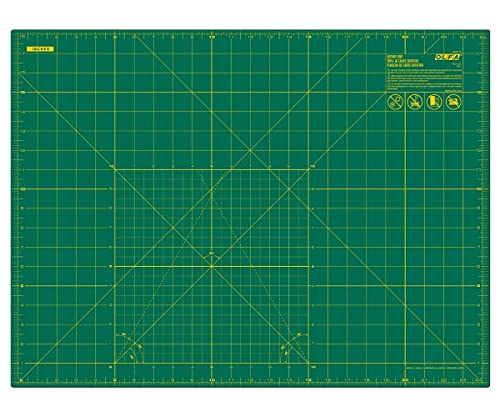 TOP CHOICEBest for quilting and sewingOLFA 18×24" Self-Healing Rotary Cutting Mat (RM-SG) – Double-Sided, GreenView on Amazon
- 3
 TOP CHOICEBest for small workspacesOLFA 12×18" Self-Healing Rotary Cutting Mat (RM-CG) – Double-Sided, GreenView on Amazon
- 4
 Best for large-scale projectsOLFA 35×70" Connecting Rotary Mat Set (RM-CLIPS/3) – 3-Mat w/ClipsView on Amazon
- 5
 Best for trimming blocksOLFA 17×17" 360-Degree Rotating Cutting Mat (RM-17S) – Self-Healing, GreenView on Amazon
- 6
 Best budget pickOLFA 6×8" Self-Healing Rotary Cutting Mat (RM-6×8) – Double-Sided, GreenView on Amazon
Our Top Picks
Before you read the individual listings, it helps to know how this list was built. Each mat was weighed against the criteria a quilter or sewist is likely to care about: surface self-healing behavior, grid clarity, thickness, size relative to typical projects, and whether the format suits a single table or a tight corner. The comparison draws on manufacturer specifications, the brand’s long presence in the rotary cutting market, and common owner feedback about how these mats wear over time.
Quick Comparison
| Product | Best for | Key feature |
|---|---|---|
| OLFA 24×36″ Self-Healing Rotary Cutting Mat (RM-MG) | Large quilting projects | Double-sided grid, triple-layer construction |
| OLFA 18×24″ Self-Healing Rotary Cutting Mat (RM-SG) | Quilting and sewing | Mid-size footprint with double-sided grid |
| OLFA 12×18″ Self-Healing Rotary Cutting Mat (RM-CG) | Quilting and sewing in tight spaces | Heat-welded triple-layer surface |
| OLFA 35×70″ Connecting Rotary Mat Set (RM-CLIPS/3) | Large-scale quilting and sewing | Three mats join with clips for a wide work surface |
| OLFA 17×17″ 360-Degree Rotating Cutting Mat (RM-17S) | Trimming blocks and quilting shapes | 360-degree rotating base |
| OLFA 6×8″ Self-Healing Rotary Cutting Mat (RM-6×8) | Small-scale quilting | Compact double-sided self-healing mat |
OLFA 24×36″ Self-Healing Rotary Cutting Mat (RM-MG) – Double-Sided, Green
OLFA 24×36" Self-Healing Rotary Cutting Mat (RM-MG) – Double-Sided, Green | Self-healing, triple-layer, double-sided grid, rotary cutter safe – Large quilting projects – Quilters and Crafters
Best for: Large quilting projects
This is the mat for quilters who cut full-width strips, large borders and yardage. Its generous footprint lets you square up a fabric panel without repositioning it several times, and the double-sided grid means you can work from whichever face suits the cut.
Key specs
- Size: 24 x 36 inches
- Double-sided printed grid
- Triple-layer self-healing construction
- Rotary cutter safe
Pros
- Large surface accommodates wide fabric without folding.
- Double-sided grid gives a second layout option.
- Self-healing surface closes small blade channels after cutting.
Cons
- Takes up significant table space and may not fit a small craft desk.
- Heavier to move than smaller mats.
Bottom line: Pick this if you regularly cut full-width fabric and have a dedicated table. It is the most practical single mat for quilt-sized work.
View on AmazonOLFA 18×24″ Self-Healing Rotary Cutting Mat (RM-SG) – Double-Sided, Green
OLFA 18×24" Self-Healing Rotary Cutting Mat (RM-SG) – Double-Sided, Green | Self-healing, triple-layer, double-sided grid, rotary cutter safe – Quilting and sewing – Quilters and Crafters
Best for: Quilting and sewing
A versatile middle size that suits most quilting and garment sewing. It covers a fat quarter comfortably, handles half-yard cuts and still fits on a standard sewing table alongside a machine.
Key specs
- Size: 18 x 24 inches
- Double-sided printed grid
- Triple-layer self-healing construction
- Rotary cutter safe
Pros
- Good balance of working area and footprint.
- Grid suits common quilting rulers and strip widths.
- Double-sided design extends its usefulness.
Cons
- Too small for cutting wide yardage in one pass.
- Edges can curl over time if stored rolled.
Bottom line: The best all-round choice for someone who wants one mat for quilting and sewing without committing to a very large surface. A related read: 5 Best US Art Supply Cutting Mats for Crafts and Quilting (2026).
View on AmazonOLFA 12×18″ Self-Healing Rotary Cutting Mat (RM-CG) – Double-Sided, Green
OLFA 12×18" Self-Healing Rotary Cutting Mat (RM-CG) – Double-Sided, Green | Self-healing, triple-layer heat welded, double-sided, rotary mat – Quilting and sewing – Quilters and Crafters
Best for: Quilting and sewing in tight spaces
This mat suits sewists with limited room, or anyone who cuts smaller pieces such as binding strips, applique shapes and patchwork units. It is easy to slide out for a quick cut and store away afterward.
Key specs
- Size: 12 x 18 inches
- Double-sided grid
- Triple-layer heat-welded self-healing construction
- Rotary cutter safe
Pros
- Compact enough for a crowded table or a travel case.
- Heat-welded layers are designed to stay together under repeated cutting.
- Good size for individual blocks and small pieces.
Cons
- Limited area for larger strip sets or full-width fabric.
- Will need frequent repositioning on bigger projects.
Bottom line: A sensible choice for small-space sewists or as a second mat beside a larger one.
View on AmazonOLFA 35×70″ Connecting Rotary Mat Set (RM-CLIPS/3) – 3-Mat w/Clips
OLFA 35×70" Connecting Rotary Mat Set (RM-CLIPS/3) – 3-Mat w/Clips | Three 23×35 self-healing mats, 1.5mm, connect with clips – Large-scale quilting and sewing – Quilters and Crafters
Best for: Large-scale quilting and sewing
Designed for those who work on oversized pieces such as large quilt tops, backing fabric and wide-format layouts. Three mats connect with clips to form one long working surface.
Key specs
- Set size: 35 x 70 inches when joined
- Three 23 x 35 inch self-healing mats
- Approximately 1.5 mm thickness per mat
- Connects with clips
Pros
- Creates a very wide continuous cutting area.
- Mats can be separated and stored individually.
- Clips keep sections aligned during cutting.
Cons
- Requires a large, flat table or floor space.
- Seams between mats can catch a rotary blade if not aligned carefully.
Bottom line: Choose this for large quilts and wide fabric, and only if you have the space to set it up and keep it flat.
View on AmazonOLFA 17×17″ 360-Degree Rotating Cutting Mat (RM-17S) – Self-Healing, Green
OLFA 17×17" 360-Degree Rotating Cutting Mat (RM-17S) – Self-Healing, Green | Two-piece rotating, 360-degree spin, self-healing surface – Trimming blocks and quilting shapes – Quilters and Crafters
Best for: Trimming blocks and quilting shapes
The rotating base lets you turn a block without lifting it, which makes squaring up and trimming faster. It suits quilters who cut many units with the same orientation.
Key specs
- Size: 17 x 17 inches
- Two-piece rotating design
- 360-degree rotation
- Self-healing surface
Pros
- Rotation reduces handling of delicate blocks.
- Square footprint suits block trimming well.
- Two-piece construction is easy to store.
Cons
- Rotating base is less stable for long, straight cuts across wide fabric.
- Smaller working area than a standard rectangular mat.
Bottom line: A useful specialty mat for block-heavy quilting, best paired with a larger mat for straight cuts.
View on AmazonOLFA 6×8″ Self-Healing Rotary Cutting Mat (RM-6×8) – Double-Sided, Green
OLFA 6×8" Self-Healing Rotary Cutting Mat (RM-6×8) – Double-Sided, Green | Self-healing, triple-layer, double-sided grid, rotary cutter safe – Small-scale quilting – Quilters and Crafters
Best for: Small-scale quilting
A small, inexpensive-to-replace surface for trimming threads, cutting small appliqué pieces or working on a bag or travel project. It is also handy as a dedicated cutting pad for a sewing desk drawer or lap.
Key specs
- Size: 6 x 8 inches
- Double-sided grid
- Triple-layer self-healing construction
- Rotary cutter safe
Pros
- Very portable and easy to store.
- Good for precise, small-scale cuts.
- Works as a cutting surface for crafts beyond sewing.
Cons
- Too small for most quilting or garment cutting.
- Will wear faster under heavy use because of its limited surface.
Bottom line: Suitable as a supplemental or travel mat, not as a primary cutting surface.
View on AmazonBuying Guide
Size and Working Area
Start with the widest piece you cut regularly. A mat should be at least as large as your longest typical cut, with room to spare for the rotary cutter’s path. For most quilters, an 18×24 or 24×36 inch mat covers the bulk of tasks. Measure your table first, and leave at least a few inches of clearance on all sides so the mat can lie flat without sliding.
Good picks for this: OLFA 24×36″ Self-Healing Rotary Cutting Mat (RM-MG), OLFA 18×24″ Self-Healing Rotary Cutting Mat (RM-SG)
Self-Healing Surface Quality
The self-healing property is what separates a rotary mat from a cardboard or foam board. The surface should close small blade channels after each pass so that the next cut stays clean. Triple-layer construction is the standard approach for this, with a core that absorbs blade pressure and outer layers that recover. Keep in mind that even the best self-healing surface wears with use; heavy cutting in the same spot will eventually show grooves.
Good picks for this: OLFA 12×18″ Self-Healing Rotary Cutting Mat (RM-CG), OLFA 6×8″ Self-Healing Rotary Cutting Mat (RM-6×8)
Grid Markings and Accuracy
Look for clear, printed grid lines in both inches and, if you work in metric, centimeters. Double-sided grids give you a second layout option and can extend the life of a mat when one side becomes worn. Accuracy matters most for quilt piecing, where small errors compound across a block. Check that the grid lines are crisp and that the squares are truly square before buying.
Good picks for this: OLFA 24×36″ Self-Healing Rotary Cutting Mat (RM-MG), OLFA 18×24″ Self-Healing Rotary Cutting Mat (RM-SG)
Thickness and Stability
Thickness affects both comfort and blade protection. Thicker mats absorb more blade pressure and last longer under heavy use, but they are heavier and less flexible. Manufacturers often specify thickness for their connecting mats at about 1.5 mm per section. A stable mat that does not slide on your table is essential for safe cutting, so consider a non-slip backing or a mat that sits flat without curling.
Good picks for this: OLFA 35×70″ Connecting Rotary Mat Set (RM-CLIPS/3), OLFA 17×17″ 360-Degree Rotating Cutting Mat (RM-17S)
Use Case and Project Type
Match the mat to what you actually make. Quilters working with fat quarters and strip sets need a mid-size or large mat. Garment sewists who cut patterns benefit from a long surface. Block-based quilters who trim many units may appreciate a rotating mat. Small craft projects need only a compact surface. Write down your three most common projects before deciding.
Good picks for this: OLFA 17×17″ 360-Degree Rotating Cutting Mat (RM-17S), OLFA 6×8″ Self-Healing Rotary Cutting Mat (RM-6×8)
Durability and Wear
Mats wear unevenly. The center of the work area typically shows the most grooves, which is why double-sided mats are useful. Store mats flat or loosely rolled rather than tightly creased. Owners commonly report that keeping a mat away from heat and direct sunlight helps preserve the self-healing surface. Replace a mat when cuts stop closing cleanly or when grooves interfere with accuracy.
Good picks for this: OLFA 24×36″ Self-Healing Rotary Cutting Mat (RM-MG), OLFA 12×18″ Self-Healing Rotary Cutting Mat (RM-CG)
Care and Cutting Safety
Always use a sharp blade and keep your fingers well away from the cutting path. Replace rotary blades regularly, since a dull blade drags and can tear fabric. Clean the mat occasionally with a damp cloth to remove lint and debris, and avoid harsh solvents. For safety guidance on cutting tools, the Consumer Product Safety Commission and the Occupational Safety and Health Administration publish general information on handling sharp tools.
Good picks for this: OLFA 18×24″ Self-Healing Rotary Cutting Mat (RM-SG), OLFA 6×8″ Self-Healing Rotary Cutting Mat (RM-6×8)
FAQ
What size olfa self-healing rotary cutting mat should a beginner buy?
An 18×24 inch mat is a practical starting point. It is large enough for fat quarters, half-yard cuts and most quilt blocks, yet still fits on a standard sewing table. Beginners who work in very small spaces may prefer a 12×18 inch mat.
Can I use a rotary cutter on any self-healing mat?
No. Use a mat that is labeled rotary cutter safe. Standard cutting boards or craft mats can be damaged by a rotary blade and may not close cuts properly. The OLFA mats in this list are designed for rotary use.
How do I know when a self-healing mat needs replacing?
Replace the mat when cuts no longer close cleanly, when deep grooves show in the working area, or when the surface has become uneven enough to affect accuracy. Checking the mat periodically against a square ruler can reveal warping before it affects your work.
Is a double-sided mat worth it?
Often, yes. A double-sided mat offers a second grid layout and can extend its useful life when one face becomes heavily grooved. Most owners who use one side heavily find the reverse side useful for a second round of cutting.
How do I store a large self-healing mat?
Store large mats flat if possible, or loosely rolled with the cutting surface facing inward. Avoid folding, which can crease the surface. Keep mats away from heat sources and direct sunlight, which owners often report can degrade the self-healing layer over time.
Can I connect different sizes of OLFA mats together?
The connecting set in this list is built from three matching mats joined with clips, so it is designed as a system. Mixing unrelated mats is not recommended, since mismatched thickness and edges can create uneven seams that catch the blade.
Do self-healing mats work for non-fabric crafts?
Yes. Many people use them for paper, vinyl, card stock and light craft materials. Use a sharp blade appropriate for the material, and check that the rotary cutter suits the thickness you are cutting.
Conclusion
For most quilters, the OLFA 24×36 inch mat offers the best combination of working area and grid utility, while the 18×24 inch mat is the most versatile middle choice for quilting and sewing. If space is tight, the 12×18 inch mat and the 6×8 inch mat cover smaller needs. The connecting three-mat set suits large-scale projects where a wide, continuous surface matters, and the 17×17 inch rotating mat helps with block trimming. Match the size to your most common cut, check that the surface is rotary cutter safe, and replace it once cuts stop closing cleanly.
Sources
- Consumer safety information on handling sharp tools and reducing cutting injuries (cpsc.gov)
- General workplace guidance on safe use of cutting tools and blade handling (osha.gov)
Related reading
- 7 Best Self-Healing Rotary Cutting Mat Options for Quilting and Sewing (2026)
- 6 Best Self Healing Cutting Mats for Rotary Cutter Users in 2026
- Self-healing Cutting Mat Clear (2026): Which Should You Choose?
- Self-healing Cutting Mat 24×36: How to Choose and Use One Well (2026)
- Self Healing Cutting Mat Quilting: How to Choose and Use One Well
- Self Healing Cutting Mat Pink (2026): Which Should You Choose?
- Self Healing Cutting Mat Custom Size: How to Choose the Right Dimensions
- Largest Self Healing Cutting Mat: 7 Best for Large Projects (2026)
About Emily Parker
Emily Parker is part of our editorial team and reviews and edits our sewing supplies guides, checking product details against manufacturer specifications and owner feedback.
About the author
Emily Parker writes reviews and buying guides for Sewing Thread Online.