Top 5 Machine Needles for Quilting: Our Picks for Every Need
Compare the best machine needles for quilting by fabric, thread and machine type. Find the right size, point and pack for piecing and free-motion work.
 By Colin Foster
Updated November 20, 2026
 By Colin Foster
Updated November 2026
Choosing machine needles for quilting comes down to four things: the needle size that matches your thread and batting, the point style that suits cotton piecing versus free-motion stitching, the shank type your machine takes, and whether the pack gives you enough needles for a full project. The five picks below were compared on those criteria using product listings, brand reputation and common owner feedback. We did not test them ourselves.
Best overall: Euro-Notions 71834 Quilt Needles – View on Amazon
Best for multi-size stock: HAX1 Universal Assortment – View on Amazon
Best for heavy quilting: 30PCS Universal Heavy Duty Assortment – View on Amazon
Best for piecing precision: SCHMETZ Microtex Sharp – View on Amazon
Best for dedicated quilting: SCHMETZ Quilting Needles 90/14 – View on Amazon
Our Top Picks
| Product | Best for | Key feature |
|---|---|---|
| Euro-Notions 71834 Quilt Machine Needles | Overall quilting use | Size 14/90 quilting point |
| SCHMETZ Quilting Needles | Dedicated quilting work | Size 90/14 in 5-needle cards |
| SCHMETZ Microtex Sharp Sewing Machine Needles | Precise piecing seams | Sharp point, size 80/12 |
| 30PCS Universal Heavy Duty Sewing Machine Needles | Thick layered quilts | Sizes 90/14 to 110/18 |
| HAX1 Universal Sewing Machine Needles | Mixed projects and sizes | Five sizes, 50-piece pack |
Euro-Notions 71834 Quilt Machine Needles-Size 14/90 5/Pkg
Euro-Notions 71834 Quilt Machine Needles-Size 14/90 5/Pkg
Best for: Overall quilting use
This suits quilters who want one dependable needle size for standard cotton quilt tops and batting sandwiches.
Pros
- Size 14/90 matches common quilting thread weights.
- Five needles per pack covers a full project.
Cons
- Only one size, so you will need others for lightweight fabrics.
SCHMETZ Quilting Needles – Size 90/14, 5-Needle Cards, Pack of 1
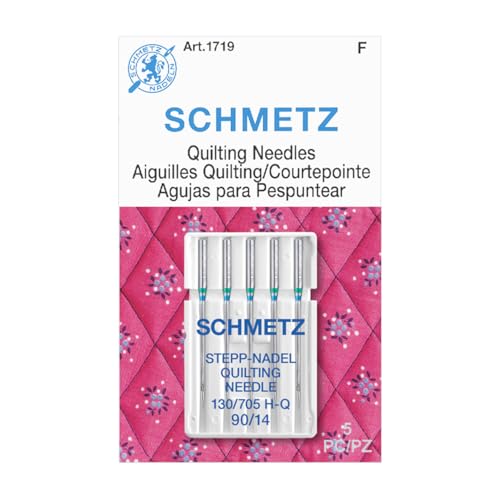
SCHMETZ Quilting Needles – Size 90/14, 5-Needle Cards, Pack of 1
Best for: Dedicated quilting work
Quilters who already trust SCHMETZ and want a needle designed specifically for quilt construction and machine quilting.
Pros
- Quilting point is made for stitching through multiple layers.
- Size 90/14 is a common starting point for quilting cotton.
Cons
- Single size per card.
SCHMETZ Microtex Sharp Sewing Machine Needles – Quilting & Topstitching Supplies, Size 80/12, 5-Needle Card, Pack of 5

SCHMETZ Microtex Sharp Sewing Machine Needles – Quilting & Topstitching Supplies, Size 80/12, 5-Needle Card, Pack of 5
Best for: Precise piecing seams
Piecers working with fine cottons and precise quarter-inch seams who want clean, accurate stitching.
Pros
- Sharp point penetrates tightly woven cotton cleanly.
- Good for topstitching and detailed seam work.
Cons
- Less forgiving on thick batting layers.
30PCS Size 90/14 100/16 110/18 Universal Sewing Machine Needles | Heavy Duty Sewing Machine Needle for Thick Fabric

30PCS Size 90/14 100/16 110/18 Universal Sewing Machine Needles | Heavy Duty Sewing Machine Needle for Thick Fabric Including Canvas Leather Embroidery Jeans
Best for: Thick layered quilts
Quilters stitching wool batting, denim or multiple heavy layers who need sturdier needles in larger sizes.
Pros
- Larger sizes resist bending through dense layers.
- Thirty needles gives you a generous supply.
Cons
- Universal point is less specialized than a quilting point.
Sewing Machine Needles 50 PCS HAX1 Universal 5 Sizes

Sewing Machine Needles 50 PCS HAX1 Universal 5 Sizes Compatible with Singer | Compatible with Singer, Brother, Janome & Varmax. Sizes: 65/9, 75/11, 90/14, 100/16, 110/18. Universal, Smooth Stitching
Best for: Mixed projects and sizes
Sewists who move between quilting, garment sewing and home decor and want several sizes on hand.
Pros
- Five sizes from 65/9 to 110/18 cover most projects.
- Large pack lasts a long time across varied work.
Cons
- Universal points are not optimized for quilting alone.
Buying Guide
Needle size
Match the needle to your thread: finer thread needs a smaller needle, and heavier batting needs a larger one. Size 90/14 is a common starting point for quilting cotton, while 75/11 suits lighter fabric. For more detail, see What Size Sewing Machine Needles for Quilting: 75/11 vs 90/14 (2026).
Needle point
Quilting points are designed to slip between fabric threads without damaging them, which matters when stitching through several layers. Sharp points suit precise piecing of tightly woven cotton.
Shank and machine compatibility
Check your machine manual for the shank type before buying. Most household machines use a standard flat shank, but mismatched brands can cause fit problems. Sewing Machine Needles Singer: How to Choose and Change the Right One covers this in more depth.
Pack size and variety
Quilters who change needles often for thread and batting combinations benefit from assorted packs, while those doing one project type can buy a single size in bulk.
Good picks for this: Euro-Notions 71834 Quilt Machine Needles and SCHMETZ Quilting Needles
FAQ
What size machine needle should I use for quilting?
Most quilters start with a size 90/14 quilting or universal needle, which handles standard quilting cottons and typical batting well. Lighter fabrics may call for a finer needle, while very thick layers or heavy batting may need a larger size. Check your thread weight as well, since the needle eye should comfortably fit the thread you plan to use.
What is the difference between a quilting needle and a universal needle?
A quilting needle has a tapered, sharp point designed to pass cleanly through multiple layers of fabric and batting without skipping stitches. A universal needle has a slightly rounded point meant for a wider range of woven fabrics. For most patchwork and quilt-top work, a quilting or microtex-style needle is the better choice.
How often should I change my machine needle while quilting?
A good rule is to change the needle after about eight hours of sewing or at the start of each new project. A dull or bent needle can cause skipped stitches, thread breakage and damage to your fabric. Changing needles regularly is one of the simplest ways to improve stitch quality.
Do I need a specific shank type for my sewing machine?
Most home machines use either a flat-shank or a round-shank needle, and some brands require their own proprietary style. Check your machine manual before buying, or look for needles labeled as compatible with your brand. Using the correct shank ensures the needle seats properly and sews reliably.
Is a multi-size assortment pack worth buying for quilting?
An assortment pack is useful if you work on a variety of projects, since it lets you switch sizes for different fabrics and thread weights without extra shopping. If you mostly quilt with one weight of fabric, a pack of a single size may be more economical. Assortments are also handy for keeping spares on hand.
Can one needle type work for both piecing and free-motion quilting?
Many quilters use a quilting or microtex needle for both piecing and free-motion work, since these needles perform well in multiple layers. Free-motion quilting sometimes benefits from a slightly smaller size to reduce thread strain at speed. Testing on a scrap sandwich of your fabric and batting is the best way to confirm your choice.
Conclusion
If you want one dependable needle for everyday quilting, the Euro-Notions quilt needles are a sensible starting point, and the SCHMETZ quilting needles are a good alternative for piecing and general use. Quilters who switch between fabric weights or sewing tasks will get more value from the HAX1 universal assortment, while those tackling dense layers or heavy batting should look at the heavy-duty assortment.
For precise topstitching and fine piecing, the SCHMETZ Microtex needles are worth considering. Match the size and point to your fabric and machine, and the right pick will be the one that fits your everyday projects best.
Related reading
- Sewing Quilting Embroidery Machine Computerized Screen Automatic Needle Threader: A Practical Guide (2026)
- Longarm Quilting Machine Needles vs Standard Needles: Which Should You Choose?
- 5 Best Sewing Machine Quilting Needles for Piecing and Quilting (2026)
About Colin Foster
Colin Foster is part of our editorial team and reviews and edits our sewing supplies guides, checking product details against manufacturer specifications and owner feedback.
About the author
Colin Foster writes reviews and buying guides for Sewing Thread Online.